Look first, then save
Flying blind always costs more In my years as a banker, I learned a simple truth: you can't manage what…

Cloud burnout #11
Developers, engineers, and application managers make decisions every day with direct financial consequences, without ever seeing those consequences themselves. No feedback, no link between action and outcome, no ownership. In this blog, Edco Wallet explains why cost awareness is the forgotten lever in Azure FinOps.
I’ve seen a lot of organizations from the inside over the course of my career. And if one thing has stuck with me, it’s this: people change their behavior when they feel the consequences of their choices. Not because they have to. But because it becomes real to them.
In the cloud, the opposite happens. Developers, engineers, and application managers make decisions every day with direct financial consequences. A VM sized a bit bigger than needed. An environment left running over the weekend. Storage that never gets cleaned up. Small choices. But add them all up, and there’s last month’s invoice.
The problem isn’t that people don’t care about costs. The problem is that they don’t see them. No feedback. No link between action and outcome. No ownership.
In a traditional on-premises environment, the threshold for new capacity was something you could actually feel. Order hardware, request a budget, arrange approval, wait. Not exactly fast, but it created a moment of awareness. Someone had to make a decision. Someone had signed off on it.
Azure works differently. Deploying a VM takes seconds. No form, no signature, no price tag right there in front of you. The room to spend is simply there, until the month runs out. And then the invoice arrives.
That invisibility isn’t a flaw. It’s the whole point of the cloud: speed and flexibility. But the side effect is that financial responsibility has become vague. The invoice lands with finance, or with the IT manager. The decisions that shaped that invoice were spread across dozens of people who never got any feedback on them.
We see it in nearly every Azure Cost Scan we run: the moment teams get to see their own usage data (exactly how much they’re consuming, which resources belong to them, what it costs per month) the conversation changes immediately.
Not defensively. Not guiltily. Curiously. “I didn’t know that.” “Oh, that test environment is still up?” “What if we made that VM smaller?”
That’s the moment ownership begins. Not when someone imposes it on you, but when you can see it for yourself. Knowledge creates responsibility but only if that knowledge actually gets shared.
In most organizations, it doesn’t. Cost insight is reserved for a small group. The people actually making the decisions (developers, engineers, team leads) see nothing. They’re building inside a financial vacuum.
I hear it regularly: “Our team just doesn’t have cost awareness.” Or: “They only think about the tech, not the money.”
I don’t buy that. The people aren’t the problem. The lack of information is.
If a developer has no idea their test environment costs €800 a month, it’s not exactly surprising that they leave it running. They’re doing their job. If that same developer gets a monthly overview of their usage, broken down by resource, compared to the month before, conversations start happening on their own. Choices get made more deliberately.
That’s not a soft skill. That’s just good information.
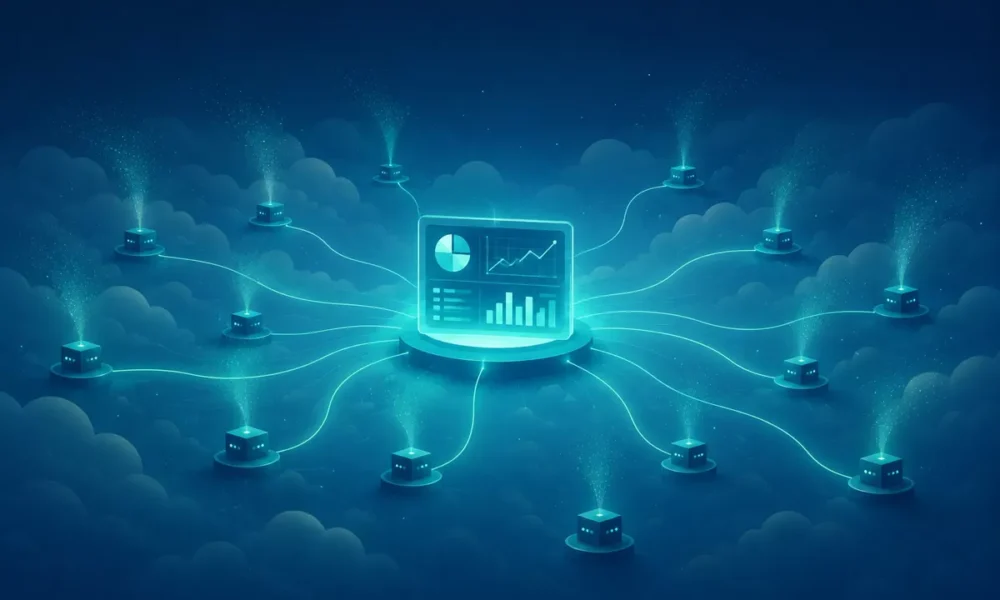
With CloudXcellence, we map usage at the team and user level. Who’s running which resources? What does it cost? How has that changed over the past few months?
We share that insight actively, not just with IT management, but with the teams themselves. Through reports that are easy to understand without needing to be a FinOps expert. Combined with our consultants, who help teams understand what they’re looking at and what they can actually do about it.
What that delivers in practice: teams that spot and clean up inactive resources on their own. Engineers who more deliberately choose smaller VM types for non-production environments. Team leads who factor cost responsibility into sprint planning. A shift from “the cloud is free” to “I know what my work costs.”
That might sound like a big shift. But it starts small. With a simple monthly overview. With one conversation.
Ownership in the cloud isn’t a one-time project. It’s an ongoing process of sharing information, setting up feedback loops, and building awareness. You don’t get there with one workshop. You get there by showing people what’s being used, every month, and giving them the room and the tools to act on it.
The cloud has become democratic in how resources get consumed. But the responsibility for that has never become democratic in the same way. That gap, between who decides and who sees the bill, is the core of cloud burnout #11.
The fix is simple, in principle: give people insight into their own usage. Give them the tools to understand it. And give them the room to act on it. The rest follows on its own.
Want to know what ownership could look like in your organization? Get in touch for a no-obligation conversation.
This problem is part of a bigger pattern. In the “12 Cloud Burnouts” whitepaper, we describe all twelve cost pitfalls in Azure environments. And if you want to understand how cost allocation and tagging lay the groundwork for ownership, those blogs are worth a read too.
This is part 11 of a 12-part series on the most costly Azure pitfalls. Every two weeks, we cover one “burnout” with practical fixes you can apply right away.